




Navigating a garden should be a source of joy, not frustration. If you’re searching for the best garden paths for wheelchairs, you need surfaces that are firm, stable, and slip-resistant in all weather conditions. The right pathway transforms an outdoor space from an obstacle course into a place of relaxation and independence. Choosing the correct materials, dimensions, and layout ensures that manual and power wheelchair users can move freely without getting stuck or risking a fall. This guide covers everything required to build or upgrade an accessible route through your yard.
Key Takeaways : Best garden paths for wheelchairs

- Maintain a minimum clear path width of 36 inches, though 48 to 60 inches is ideal for comfortable turning and passing.
- Poured concrete and interlocking pavers provide the most reliable, low-maintenance surfaces for wheelchair navigation.
- Keep cross slopes under two percent and running grades under five percent to prevent chairs from drifting or requiring excessive effort to push.
- Avoid loose materials like standard gravel, wood chips, and sand, as they cause wheels to sink and make propulsion nearly impossible.
- Install flush transitions between different surface types to eliminate tripping hazards and jarring bumps for wheelchair users.
- Ensure proper drainage beneath and beside the path so water doesn’t pool and create slippery conditions or frost heaves.
Why Surface Stability Matters Most
The foundation of any accessible route is its surface quality. According to accessibility standards, a ground surface must be firm, stable, and slip-resistant. A firm surface doesn’t deform under the weight of a wheelchair and its occupant. Soft ground, wet soil, or loose stones will compress, causing the wheels to sink and creating resistance that exhausts the user or drains the battery of a power chair.
Stability refers to the material’s ability to remain in place over time. Materials that shift, spread out, or wash away during heavy rain fail this requirement. A stable base prevents ruts from forming after repeated use. Slip resistance is equally critical, particularly in climates with frequent rain, morning dew, or winter ice. Smooth, polished stone might look attractive, but it becomes dangerously slick when wet.
When evaluating materials, consider how they perform across seasons. A path that works perfectly in dry summer conditions might turn into a muddy trap in spring. Wheelchair tires, especially the narrow front casters, are highly sensitive to surface irregularities. Even a half-inch gap or a soft patch can stop a manual wheelchair in its tracks or cause a power chair to veer unexpectedly. Prioritizing surface integrity over pure aesthetics is the most important decision you’ll make for an accessible garden.
What Are the Best Path Materials?
Selecting the right material dictates the longevity, maintenance, and usability of your garden path. Below is a comparison of the most common options used in residential landscaping, evaluated specifically for wheelchair accessibility.
| Material | Firmness | Maintenance Level | Estimated Cost per Square Foot | Wheelchair Suitability |
|---|---|---|---|---|
| Poured Concrete | Excellent | Low | $6 – $15 | Ideal; smooth and durable |
| Interlocking Pavers | Very Good | Medium | $10 – $25 | Excellent if installed flush |
| Resin-Bound Gravel | Good | Low | $8 – $18 | Good; binds loose stones firmly |
| Asphalt | Very Good | Medium | $4 – $9 | Very good; smooth but heats up |
| Natural Flagstone | Fair to Good | High | $15 – $35 | Poor unless cut very flat |
| Loose Gravel | Poor | High | $1 – $4 | Unusable; wheels sink deeply |
Poured concrete remains the gold standard for wheelchair pathways. It provides a seamless, uniform surface that requires minimal upkeep. Broom-finished concrete offers excellent slip resistance without creating too much rolling friction. Interlocking concrete pavers are a strong alternative, offering more visual variety. However, they must be installed with extremely tight joints and a perfectly level sand bed to prevent the edges from catching small front caster wheels.
Resin-bound gravel is a modern solution that combines the natural look of loose aggregate with the stability of a solid surface. The stones are mixed with a clear resin and troweled smooth, creating a porous, firm layer that wheelchairs can roll over easily. Loose gravel, bark mulch, and sand should be strictly avoided on the main travel route, as they offer no structural support for wheels.
How Wide Should Garden Paths Be?
Dimensions dictate whether a wheelchair user can navigate the garden independently or requires constant assistance. The absolute minimum clear width for a single wheelchair is 36 inches. This measurement refers to the unobstructed space between curbs, raised beds, walls, or overhanging plants. However, 36 inches leaves virtually no margin for error. A wider path reduces anxiety and physical strain.
For a truly comfortable experience, aim for a clear width of 48 inches. This allows a manual wheelchair user to propel themselves with full arm extension without their knuckles scraping against borders. If the garden path is intended for two people to travel side-by-side—one in a wheelchair and one walking—or if two wheelchairs need to pass each other, the path must be at least 60 inches wide.
Don’t forget vertical clearance. Overhanging branches, archways, and pergolas must provide at least 80 inches of headroom. Power wheelchairs with elevated seating or canopy attachments require even more vertical space. Additionally, ensure that plantings along the border don’t encroach on the path as they mature. A shrub planted two feet away today might block half the walkway in three years. Regular pruning is essential to maintain the designed dimensions.
Best Garden Paths for Wheelchair Access
Creating the best garden paths for wheelchairs involves combining the right materials with thoughtful design features that accommodate mobility devices. A truly accessible path isn’t just a flat piece of ground; it’s a carefully engineered route that anticipates the needs of the user.
One of the most effective designs is a continuous loop rather than a dead-end path. Dead ends force a wheelchair user to perform multi-point turns, which is exhausting and difficult in tight spaces. A circular or figure-eight layout allows continuous movement through the garden. If a dead end is unavoidable due to property lines, you must install a designated turning space at the terminus.
This turning area must be a flat, level circle with a diameter of at least 60 inches, or a T-shaped intersection that allows a three-point turn. Without this space, a user who reaches the end of a path can’t turn around without reversing the entire distance backward, which is unsafe and impractical.
Consider integrating resting spots along longer routes. A widened section of the path featuring a bench with armrests—positioned adjacent to the travel lane, never blocking it—allows users to rest. For those using manual chairs, upper body fatigue sets in quickly on long routes, making these pull-off areas essential components of the overall path design.
Managing Slopes and Gradients Safely
Gravity is the primary adversary of wheelchair navigation. A path that looks gently sloped to a walking person can be a dangerous hazard for someone in a wheelchair. The running slope—the incline in the direction of travel—should ideally be kept below five percent (a rise of one inch for every 20 inches of length). At this grade, a manual wheelchair user can propel themselves forward without excessive strain, and the chair won’t roll backward uncontrollably if they stop to rest.
If the terrain demands a steeper route, anything exceeding a five percent grade is technically considered a ramp and must adhere to stricter building codes, including the installation of handrails on both sides. Ramps should never exceed an eight percent grade for independent wheelchair users. Steeper inclines require assistance or specialized power chairs.
The cross slope—the tilt of the path from side to side for drainage—is equally important. A cross slope greater than two percent causes a wheelchair to drift continuously toward the lower edge. The user must constantly fight the chair to stay on a straight line, leading to rapid fatigue and potential joint pain.
To manage water runoff without relying on steep cross slopes, install trench drains or channel grates along the edges of the path. Ensure any grate openings are no wider than half an inch and oriented perpendicular to the direction of travel so wheelchair casters don’t drop into them.
Designing Turns and Passing Spaces
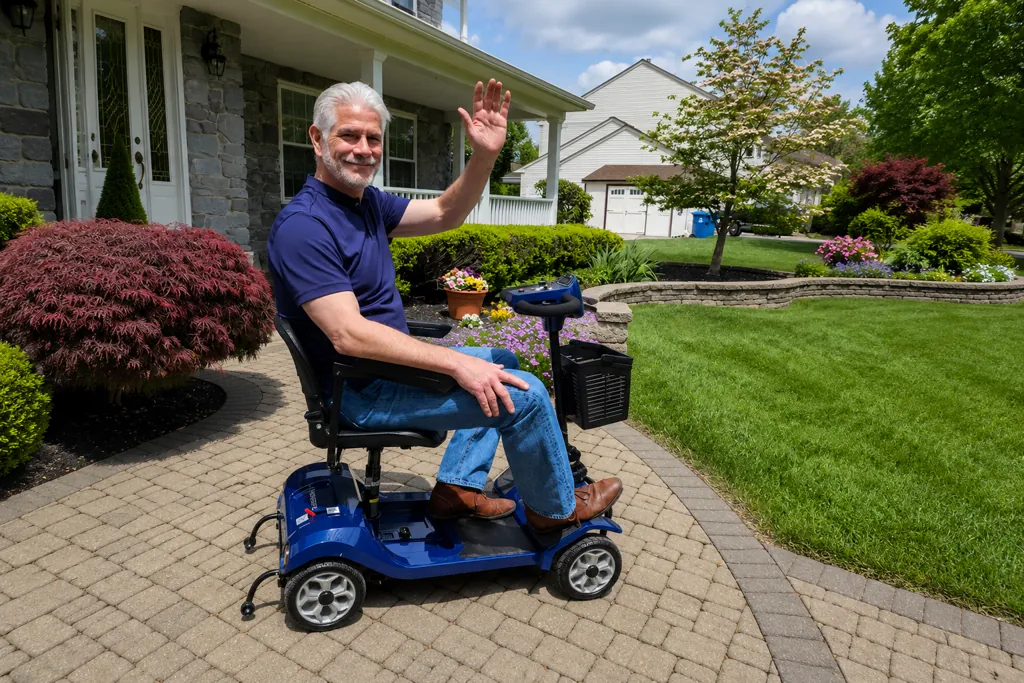
Corners in a garden path present unique challenges for mobility devices. Standard manual and power wheelchairs have a fixed turning radius determined by their wheelbase. Sharp, ninety-degree corners built at narrow widths are impossible to navigate without stopping, reversing, and turning multiple times.
To avoid this, design all corners with a sweeping curve. The outer edge of a curved path should have a radius of at least 48 inches to allow a smooth, continuous turn.
If space constraints force a sharper angle, the path must widen significantly at the corner to provide the necessary turning radius. Think of the corner as a pie slice added to the intersection, giving the front casters room to swing outward while the rear wheels pivot inside the boundary.
Passing spaces are required on any path narrower than 60 inches. If your main garden route is 48 inches wide, you must incorporate passing zones measuring at least 60 by 60 inches at reasonable intervals. A typical recommendation is to place a passing space every 200 feet. These squares allow two wheelchairs traveling in opposite directions to safely maneuver around one another without either user being forced off the paved surface and into the grass or flowerbeds.
Preventing Trips, Edges, and Hazards
A smooth surface means nothing if the transitions between materials are poorly executed. Any change in surface height greater than a quarter of an inch can catch a wheelchair caster and bring the chair to a sudden, jarring halt. Larger changes can tip the chair forward entirely. All transitions—from the patio to the garden path, or from concrete to a wooden boardwalk—must be perfectly flush transitions.
If a slight height difference is unavoidable, it must be beveled. A threshold up to half an inch high requires a beveled edge with a slope no steeper than one-to-two. Anything higher requires a proper ramp transition. Never use standard landscape timbers or railroad ties as path borders if they protrude above the walking surface. They act as speed bumps that are punishing for wheelchair users. Instead, use metal edging, poured concrete curbs, or pavers set flush with the ground.
Overhanging vegetation poses another hidden danger. Thorny bushes like roses or blackberries placed directly alongside a narrow path will scratch users’ arms as they propel their wheels. Plant thorny or spreading species at least two feet back from the path edge.
Furthermore, ensure that irrigation sprinklers don’t spray directly across the path, creating unexpected puddles and promoting algae growth, which destroys slip resistance. Drip irrigation routed beneath the soil near the path edges is the safest watering method for accessible gardens.
Drainage Solutions for Accessible Routes
Water accumulation ruins garden paths. Standing water accelerates the deterioration of asphalt and pavers, promotes moss and algae growth on concrete, and creates freezing hazards in winter. Because wheelchair paths can’t rely on steep cross slopes for drainage, you must engineer alternative ways to move water off the surface.
Permeable paving systems are an excellent choice. Products like permeable interlocking concrete pavers allow rainwater to filter down through the joints into a crushed stone base below, keeping the top surface completely dry. Resin-bound gravel also offers natural permeability. When using impermeable surfaces like poured concrete, direct the subtle two-percent cross slope toward a landscaped swale or a dedicated drainage channel.
French drains installed parallel to the path intercept groundwater before it seeps under the paving material and causes frost heaves. Frost heaves occur when trapped water freezes and expands, pushing sections of the path upward and creating severe trip hazards.
A well-compacted sub-base consisting of several inches of crushed aggregate is mandatory in cold climates. This sub-base preparation ensures that the surface remains level year after year, regardless of freeze-thaw cycles. Always verify local building codes regarding stormwater management, as some municipalities restrict where driveway and path runoff can be directed.
Maintaining Your Wheelchair-Friendly Path
An accessible garden path requires ongoing attention to remain safe. Weather, foot traffic, and surrounding plant life constantly threaten the surface quality. Establishing a routine maintenance schedule prevents minor issues from becoming impassable obstacles.
In autumn, fallen leaves become incredibly slippery when wet, posing a major hazard for wheelchair tires. Clear leaves from paved surfaces frequently. In winter, avoid using harsh chemical de-icers containing sodium chloride on concrete pavers, as they accelerate spalling and cracking. Use pet-safe, plant-friendly ice melt products formulated for hardscapes, or apply traction grit. Sand can be used for temporary traction, but it must be swept away completely in spring, as it acts like ball bearings under wheelchair wheels.
Weeds growing between paver joints lift the stones unevenly, destroying the flush surface. Apply a polymeric sand to the joints during installation, which hardens like cement when wet but retains slight flexibility, preventing weed growth and ant infestations. Inspect the path quarterly for cracks. Fill hairline cracks in concrete with a self-leveling polyurethane sealant before water enters and expands them.
| Season | Primary Maintenance Task | Hazard Addressed | Recommended Tool or Product |
|---|---|---|---|
| Spring | Sweep away winter grit and inspect joints | Loose debris causing slips | Stiff bristle broom, polymeric sand |
| Summer | Trim border vegetation and check for heaves | Encroaching plants, uneven surfaces | Pruning shears, masonry level |
| Autumn | Remove wet leaves frequently | Extreme slipperiness | Leaf blower, plastic rake |
| Winter | Apply safe ice melt proactively | Black ice formation | Calcium magnesium acetate ice melt |
Pro Tip: Wash your concrete or paver path annually with a pressure washer to remove algae and moss. However, keep the pressure below 3,000 PSI and use a wide fan nozzle. Holding a high-pressure stream too close to the surface will etch the concrete or blast the sand out of paver joints, creating new rough spots that impede wheelchair movement.
Adding Lighting and Wayfinding Features
Garden paths must be usable after dark. Poor lighting forces wheelchair users to navigate blindly, increasing the risk of veering off the path or hitting unseen obstacles. Solar-powered LED bollard lights spaced every six to eight feet along the path edges provide excellent illumination without the expense of trenching electrical wires.
Ensure the light fixtures themselves don’t intrude into the 36-inch clear width. Mount them slightly outside the path boundary or use low-profile, flush-mounted deck lights embedded directly into the paving surface. Motion-sensor floodlights at intersections or resting areas add a layer of security and convenience.
Wayfinding is also important, particularly for users with cognitive disabilities or partial vision loss who use mobility aids. Color contrast helps define the edges of the path. A light-colored concrete path bordered by dark green turf or dark mulch makes the boundaries obvious.
If the path and the surrounding ground are similar in color, install a contrasting tactile edge strip. While textured warning strips are primarily designed for visually impaired pedestrians, they also serve as a physical cue for wheelchair users that they’re nearing the edge of the safe travel zone.
Warning: Avoid placing decorative solar lights with pointed tops or fragile glass globes directly at the height of a wheelchair user’s hands. As users push their wheels along a narrow path, their hands can easily strike and break fragile fixtures, resulting in cuts. Choose durable, shatterproof polycarbonate fixtures mounted securely.
Planning Permits and Accessibility Standards

Before breaking ground, research the regulations governing exterior pathways in your municipality. While private residential gardens generally face fewer restrictions than public parks, adding permanent structures like retaining walls, extensive concrete pours, or graded ramps often triggers local zoning laws and building permit requirements.
For those looking to align their home with recognized accessibility frameworks, the United States Access Board publishes comprehensive guidelines for outdoor developed areas. Reviewing the outdoor developed areas guidelines provides exact technical specifications for running slopes, cross slopes, passing spaces, and surface firmness. Applying these professional standards to a private garden ensures the highest level of safety and usability.
Consulting a landscape architect who specializes in universal design is a worthwhile investment for complex properties with significant elevation changes. They understand how to route a path through challenging terrain while maintaining the strict gradient limits required for wheelchair access. They can also advise on soil compaction testing to ensure your chosen materials won’t sink over time.
Budgeting accurately is essential. Accessible paths cost more than standard garden stepping stones because they require wider dimensions, deeper sub-bases, and precise grading. Factor in the cost of excavation, aggregate base materials, the surface layer, edging, drainage channels, and labor. Cutting corners on the sub-base to save money will inevitably result in a ruined surface within a few seasons, costing far more to repair later.
Frequently Asked Questions
Can I use pea gravel for a wheelchair path?
No. Pea gravel is a loose aggregate that shifts under weight. Wheelchair casters will sink into it immediately, making forward propulsion nearly impossible and potentially causing the chair to tip. If you prefer the aesthetic of gravel, you must use a resin-bound gravel system where the stones are permanently glued together into a solid, flat surface.
What is the maximum slope for a garden path?
For a path to be comfortably used without being classified as a ramp, the running slope shouldn’t exceed five percent. If your terrain requires a steeper incline, it must be built as a formal ramp with a maximum slope of roughly eight percent, equipped with handrails on both sides and level landings at regular intervals.
Are brick paths good for wheelchairs?
Traditional clay bricks can work, but only if they’re laid perfectly flat on a concrete slab rather than a sand bed. Bricks set in sand tend to settle unevenly over time, creating a bumpy, hazardous surface. Smooth, wire-cut bricks are preferable to heavily textured or tumbled bricks, which create excessive rolling resistance for wheelchair tires.
How do I stop my concrete path from getting slippery?
When pouring concrete, request a broom finish. The contractor drags a stiff broom across the wet concrete, creating fine ridges that provide excellent tire grip without hindering the roll of the chair. For existing smooth concrete that has become slippery, apply a clear anti-slip coating containing aluminum oxide grit to restore traction safely.
Do I need a permit to build a garden path?
It depends on your local municipality and the scope of the project. Simple, ground-level paver installations usually don’t require permits. However, if your project involves pouring large concrete slabs, altering drainage patterns, building retaining walls, or constructing graded ramps, you’ll likely need approval from your local building department before starting work.
Can power wheelchairs handle grass paths?
Standard lawns are generally unsuitable for daily wheelchair travel. Grass becomes soft and muddy when wet, causing wheels to spin and sink, which tears up the turf and strands the user. Heavy-duty power chairs with aggressive tread tires can manage short, dry stretches, but a firm, paved surface is always necessary for reliable, independent outdoor mobility.
Conclusion
Start by measuring your current garden routes with a tape measure and a digital level to identify which areas already meet the width and slope requirements. Map out a 48-inch-wide route connecting your door to your favorite garden features, then contact a local landscaping contractor experienced in hardscaping to discuss installing a poured concrete or interlocking paver surface.
{“@context”:”https://schema.org”,”@type”:”FAQPage”,”mainEntity”:[{“@type”:”Question”,”name”:”Can I use pea gravel for a wheelchair path?”,”acceptedAnswer”:{“@type”:”Answer”,”text”:”No. Pea gravel is a loose aggregate that shifts under weight. Wheelchair casters will sink into it immediately, making forward propulsion nearly impossible and potentially causing the chair to tip. If you prefer the aesthetic of gravel, you must use a resin-bound gravel system where the stones are permanently glued together into a solid, flat surface.”}},{“@type”:”Question”,”name”:”What is the maximum slope for a garden path?”,”acceptedAnswer”:{“@type”:”Answer”,”text”:”For a path to be comfortably used without being classified as a ramp, the running slope shouldn’t exceed five percent. If your terrain requires a steeper incline, it must be built as a formal ramp with a maximum slope of roughly eight percent, equipped with handrails on both sides and level landings at regular intervals.”}},{“@type”:”Question”,”name”:”Are brick paths good for wheelchairs?”,”acceptedAnswer”:{“@type”:”Answer”,”text”:”Traditional clay bricks can work, but only if they’re laid perfectly flat on a concrete slab rather than a sand bed. Bricks set in sand tend to settle unevenly over time, creating a bumpy, hazardous surface. Smooth, wire-cut bricks are preferable to heavily textured or tumbled bricks, which create excessive rolling resistance for wheelchair tires.”}},{“@type”:”Question”,”name”:”How do I stop my concrete path from getting slippery?”,”acceptedAnswer”:{“@type”:”Answer”,”text”:”When pouring concrete, request a broom finish. The contractor drags a stiff broom across the wet concrete, creating fine ridges that provide excellent tire grip without hindering the roll of the chair. For existing smooth concrete that has become slippery, apply a clear anti-slip coating containing aluminum oxide grit to restore traction safely.”}},{“@type”:”Question”,”name”:”Do I need a permit to build a garden path?”,”acceptedAnswer”:{“@type”:”Answer”,”text”:”It depends on your local municipality and the scope of the project. Simple, ground-level paver installations usually don’t require permits. However, if your project involves pouring large concrete slabs, altering drainage patterns, building retaining walls, or constructing graded ramps, you’ll likely need approval from your local building department before starting work.”}},{“@type”:”Question”,”name”:”Can power wheelchairs handle grass paths?”,”acceptedAnswer”:{“@type”:”Answer”,”text”:”Standard lawns are generally unsuitable for daily wheelchair travel. Grass becomes soft and muddy when wet, causing wheels to spin and sink, which tears up the turf and strands the user. Heavy-duty power chairs with aggressive tread tires can manage short, dry stretches, but a firm, paved surface is always necessary for reliable, independent outdoor mobility.”}}]}