



As an Amazon Associate, we earn from qualifying purchases. This post contains affiliate links – if you buy through them, we may earn a commission at no extra cost to you.
Choosing the right long-handled weeding tool depends on your specific yard conditions rather than a single universal solution. The best choice depends on whether you are hunting isolated taproots in grass, slicing seedlings between vegetables, or clearing moss from patio pavers. Claw grabbers pull roots vertically, while sharp blades slice below the soil line.
1. Fiskars Deluxe Stand-Up Weed Puller Tool

Best for: someone pulling deep taproots from open lawn grass without kneeling
This stand-up puller centers on a 39-inch shaft with an offset handle that spares your back and wrists during yard work. You place the head over the plant using the viewing window, step down on the foot platform to drive the four serrated stainless steel claws deep, and lean the shaft to lever the root out. It also features an easy-eject mechanism on the handle so you can drop the pulled weed directly into a bucket without touching dirt.
The listing recommends watering the area before use to soften harder, compacted, or clay-heavy soil. That extra step is worth it for lawn care, but this tool isn’t suited for someone who needs to weed between tightly spaced vegetable crops because the wide claw footprint will disrupt neighboring plants. It carries a lifetime warranty from the manufacturer for long-term reliability.
Good if:
- You want to extract deep taproots like dandelions and thistles from lawn turf.
- You suffer from knee or back strain when working on the ground.
- You prefer dropping weeds straight into the trash without touching them.
Skip it if:
- You need to weed tightly planted vegetable beds where claw levers might damage desirable roots.
- Your soil is dry, hard-packed clay that you don’t have time to pre-water before working.
2. 2-in-1 Garden Hoe and Weed Puller Rake 61 Inch Spring
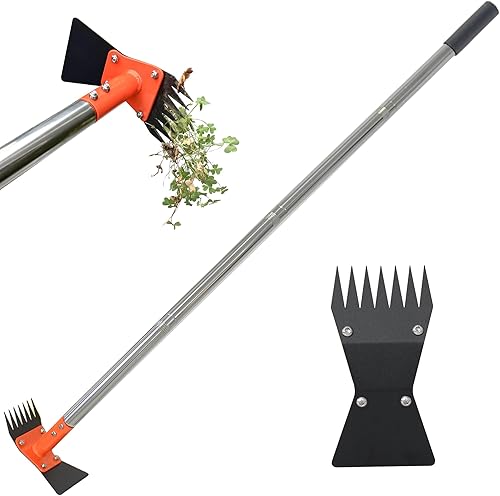
Best for: maintaining mixed garden beds and gravel paths with one tool
This tool combines a 3.75-inch wide rake on one side with a sharp trapezoid hoe on the other, mounted on an adjustable four-section handle that reaches up to 61 inches. The head is made of high-density tempered spring steel with a sand texture finish, secured by 304 stainless steel bolts to resist rust and repeated leverage stress. The rake side catches root crowns and pulls stubborn plants, while the sharp trapezoid hoe loosens compacted dirt and severs root systems.
Good if:
- You manage varied spaces like open dirt beds, gravel driveways, and border edges.
- You want the option to shorten your handle for raised garden beds.
- You prefer having a soil-loosening hoe and a weeding rake on the same head.
Skip it if:
- You want to pull dandelions from fine lawn turf without tearing the grass around them.
- You dislike checking and hand-tightening multi-section handle joints between yard sessions.
3. BARAYSTUS Crack Weeder

Best for: clearing moss and weeds from paver joints and walkways
The BARAYSTUS Crack Weeder uses an L-shaped high carbon steel blade coated for rust resistance, attached to a 55-inch stainless steel handle. Its shape lets you push, pull, or dig along straight gaps between stones to shear plant roots beneath the pavement surface. The long handle means you can work along extensive stone paths or long driveways without bending over or sitting on the pavement.
The tool comes with an explicit boundary: the listing states it works best on cracks 0.1 inch (2.5mm) or wider and less than 2 inches deep. If your pavers have hairline joint lines or interlocking sand seams narrower than that, the metal tip simply won’t fit into the groove. It’s definitely not for open garden beds or standard lawn weeding, as the thin blade has no surface area to clear broad patches of weeds.
Good if:
- You have paved patios, walkways, or long concrete driveways filled with weeds.
- You want to scrape out moss and taproots from paver joints from a standing position.
- You need an L-shaped blade that cuts in both push and pull directions.
Skip it if:
- Your hardscape has extremely tight paving gaps narrower than 0.1 inch.
- You’re looking for a general-purpose weeder to clear dirt garden beds.
4. Walensee Stand Up Weeder
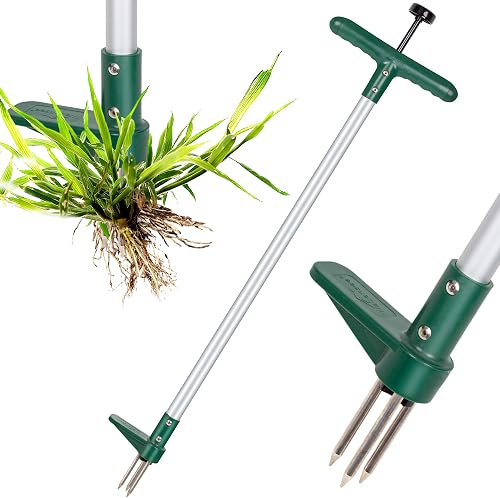
Best for: removing stubborn taproots from moist, gravel-free lawn dirt
This stand-up tool uses three 2.75-inch pointed steel tines mounted to a 39-inch tall steel shaft. You center the claws over the crown of the weed, push down using the built-in foot pedal, tilt the long handle to the side, and lift the entire weed and root system out of the lawn. The listing states it handles taproots, crabgrass, plantain, clover, burdock, and thistles without requiring hand pulling or knee pads.
A key trade-off stated by the manufacturer is that you must keep the ground moist before use and avoid rocky or gravelly soil completely. Forcing three steel claws into stony ground risks bending the pointed tines or jamming the foot mechanism. This makes the tool a poor fit for gravel driveways or uncultivated stony ground, serving strictly as a turf and clean-soil weeder.
Good if:
- You need a dedicated foot-pedal grabber to pull lawn weeds by the roots.
- You prefer a three-claw steel layout over a flat hoe blade.
- You want to work without bending down or putting strain on your knees.
Skip it if:
- Your garden soil is filled with buried stones, rocks, or gravel.
- You need to clean weeds out of tight brick pathways or driveway cracks.
5. DonSail Hoe Garden Tool -Scuffle Garden Hoes

Best for: rapidly skimming weeds off large vegetable gardens and flower borders
The DonSail Scuffle Hoe relies on a hollow loop stirrup blade that uses an intuitive back-and-forth push-pull motion. As you push and drag the head just beneath the top layer of dirt, the double-edged blade slices through weed stems and shallow roots without turning over heavy shovelfuls of dirt. The handle is made from 1.3-inch diameter steel tubing that can be assembled to 30, 43, or 60 inches depending on your height.
Good if:
- You need to weed long rows of vegetables or wide open dirt beds quickly.
- You want an adjustable handle length that can reach up to 60 inches.
- You prefer a fluid push-pull motion that slices roots right below the surface.
Skip it if:
- You need to pull out deep perennial taproots whole to stop them from regrowing.
- You’re trying to remove weeds from a grass lawn without cutting the turf.
6. 70 Inch Weeding Rake

Best for: tall gardeners needing maximum reach across wide garden beds
With a full reach of 70 inches, this LLARGUEST weeding tool provides the longest handle in this group to keep you standing tall while you work. The business end features a heavy-duty metal head with six sharp tines designed to break through hard, compacted soil, chop shallow weed roots, and collect surface debris. You can also customize the total length simply by removing or adding pole sections to fit different family members.
While the six sharp tines do great work breaking up crusty garden dirt and gathering up dead foliage, they don’t grip deep taproots. The tines act like a heavy cultivator rather than an extractor, which means deep-rooted weeds will require manual digging if they don’t tear out easily. This tool isn’t for someone who wants to clean patio gaps or extract individual dandelions without scarring the yard.
Good if:
- You’re a tall user who needs extra handle length up to 70 inches to avoid bending.
- You want to break up hard crust, weed, and rake garden debris with one tool.
- You want a tool where handle sections can be removed for shorter users.
Skip it if:
- You want an extraction tool that pulls out complete, unbroken dandelion taproots.
- You need a narrow blade for clearing between tightly packed paver stones.
7. HACHIEMON Japanese Weeding Tool Very Sharp Edge Nejiri-Gama Long Type

Best for: close-up precision weeding and scalping in dense raised beds
The HACHIEMON Nejiri-Gama is a traditional Japanese weeding sickle measuring 17.3 inches in total length, featuring a 4.8-inch curved blade forged from a specialized steel composite. Made in Japan, its razor-sharp curved edge is designed to slice into the soil at an angle, slicing off weed roots right below the surface with minimal arm effort.
The compromise here is obvious from the dimensions: with a short handle and an overall reach that is quite limited, it isn’t a stand-up tool. It requires you to sit on a garden stool, kneel, or reach directly into elevated raised planter boxes. It’s not the right match for anyone who bought a long-handled tool to avoid bending over, but it offers far greater blade precision around prized vegetables than any full-length pole could manage.
Good if:
- You maintain raised beds or planters where short tools give superior blade control.
- You want an authentic Japanese steel edge that slices cleanly through soil crust.
- You need to weed right against delicate plant stems without harming them.
Skip it if:
- You need a long-handled tool that lets you weed while standing completely upright.
- You’re looking to pull whole taproots out of lawn grass.
8. Weeding Sickle Hoe
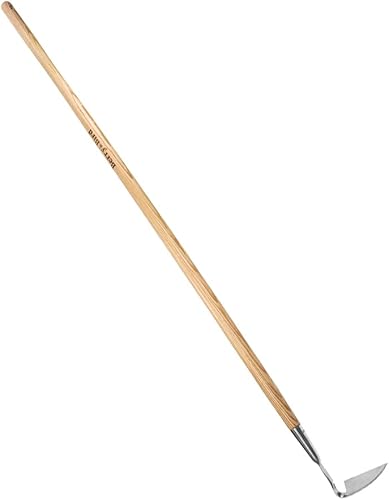
Best for: gardeners who prefer a natural wood handle and a sharp, swinging sickle blade
The Berry&Bird Weeding Sickle Hoe brings the sharp utility of a Japanese-style weed hoe to a stand-up format thanks to its 58-inch solid ash wood handle. The head holds a sharp stainless steel blade designed for slicing roots, digging, cultivating, and clearing garden beds while standing. The solid wood shaft includes a cowhide cord for hanging.
The tool requires initial assembly using the included screws and tools, so you have to assemble the head onto the wood handle yourself before hitting the dirt. The sweeping sickle design requires a slight swinging or chopping motion to cut roots, which takes more open swing room than a straight scuffle hoe. This means it isn’t ideal for crowded borders where wild swings might damage nearby flowers or stems.
Good if:
- You like the feel, look, and balance of a traditional solid ash wood handle.
- You want a sharp stainless steel sickle blade on a long, stand-up pole.
- You want a single tool that can cultivate, dig, and slice garden weeds.
Skip it if:
- You want a ready-to-use tool that requires zero assembly out of the box.
- You’re working in extremely tight clusters where swinging a curved blade is risky.
9. WORKPRO Crack Weeder

Best for: multi-surface hardscape scraping with a telescoping handle
The WORKPRO Crack Weeder combines an L-shaped scraper blade with a reinforced hook made from polished stainless steel to resist rust and dirt adhesion. Its adjustable handle offers three locking length options ranging from 27 inches up to 54 inches, letting you choose between a compact reach for stairs or full standing height for flat walks. The sharp L-blade slices turf and moss along border stones, while the pointed hook digs deep into joints to lever out stubborn taproots.
Like any tool with an L-blade profile, it’s engineered strictly for cracks, sidewalk joints, and edging boundaries. The narrow blade can’t move loose soil or clear wide weed patches across an open garden bed efficiently. It isn’t for anyone whose main chore is clearing vegetable patches, but it does an excellent job restoring paved driveways, stone steps, and brick walkways.
Good if:
- You need an adjustable handle that contracts down to 27 inches or extends to 54 inches.
- You want both an L-shaped scraping edge and a narrow root hook combined into a single versatile head.
- You have lots of sidewalks, stone pavers, or wall seams filled with moss.
Skip it if:
- You need a wide hoe to weed large, unpaved garden plots.
- You want a foot-operated weed puller for lawn dandelions.
10. Dual-Eject Weed Puller
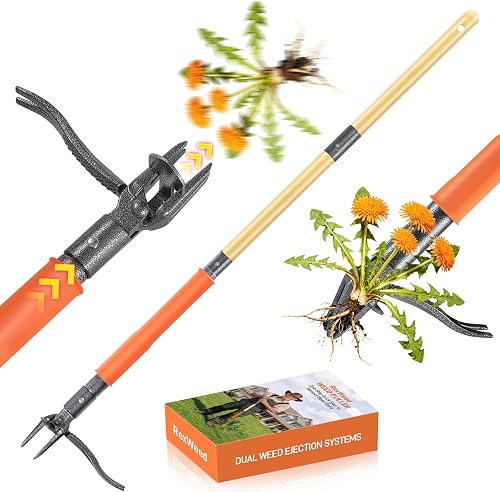
Best for: pulling lawn weeds without ever touching dirty roots or bending over
The RexWeed stand-up puller uses a 43.7-inch real bamboo handle attached to a heavy-duty steel footplate and four hardened steel claws. What sets it apart is its dual-mode ejection system: you can either slide the hand lever to drop the weed or step on the anti-slip metal pedal to pop the plant out directly. The four sharp claws penetrate 3 inches deep to surround and lift taproots from dandelions, thistles, and crabgrass cleanly.
The tool features a threaded bamboo shaft. It’s not suited for gravel paths or rock-filled dirt where the steel pedal mechanism could get jammed by stones.
Good if:
- You want two different hands-free ways to eject weeds straight into your waste can.
- You prefer the natural feel of a solid bamboo handle over metal pipes.
- You need a set of deep, durable claws to extract complete taproots in one pull.
Skip it if:
- You leave your yard tools outside in the rain where natural bamboo might weather.
Where These Overlap
Several tools on this list share identical working mechanics despite differences in brand names or minor accents. The Fiskars Deluxe Weed Puller, Walensee Stand Up Weeder, and Dual-Eject Weed Puller all tackle the exact same chore: pulling isolated taproots from lawn grass using a foot pedal and steel claws. Between those three, the choice comes down to ejection style and shaft material. The Fiskars uses an offset handle with a slide mechanism, the Walensee relies on a direct sideways tilt pull, and the RexWeed offers both hand and foot ejection on a bamboo shaft.
Similarly, the BARAYSTUS Crack Weeder and WORKPRO Crack Weeder are near-identical in function. Both feature an L-shaped stainless or carbon steel scraper built strictly to clean out narrow hardscape gaps. If you need to clear paver stones, the choice between them comes down to whether you prefer a fixed 55-inch shaft or WORKPRO’s telescoping pole that drops to 27 inches.
Still Not Sure?
How often will I really use it?
If you only head out every few weeks to tidy up, weeds will likely be tall, scattered, and deeply rooted. An extraction tool like the Fiskars Deluxe Weed Puller lets you walk the yard and pop out mature dandelions individually without wrecking your back. If you spend time in the garden every few days, broad weed seedlings won’t have deep roots yet, making a quick sweep with the DonSail Scuffle Hoe much faster.
What do I already own that this has to work with?
Think about the yard surfaces you actually spend your weekends maintaining. If you already own regular garden shovels and hand trowels but struggle with moss creeping between your brick patio steps, buying another garden hoe won’t help you. You need a dedicated narrow scraping edge that fits where standard shovels can’t, making the WORKPRO Crack Weeder the missing piece in your shed.
What am I most likely to regret choosing?
The most common regret is buying a wide cultivating tool for an established lawn, or buying a claw grabber for a vegetable plot. A hoe like the 2-in-1 Garden Hoe is not designed for selective weeding in turf grass. Conversely, using a heavy four-claw puller across a large vegetable bed will exhaust you before you finish the first row.
Also Worth Considering
The BARAYSTUS Puller 61″ Adjustable Long offers a 2-in-1 weed rake and crack weeder combination with a detachable head, making it a viable alternative if you want to switch between clearing garden beds and scraping sidewalk cracks with a single pole.
The GOXAWEE Puller Tool 45″ Long provides a classic stand-up manual weed puller format with an extended reach, giving taller gardeners another direct option for upright dandelion extraction.
The Weed Puller Tool combines a 58-inch telescoping handle with a dual hoe and rake head, packaged with work gloves for gardeners who want an all-in-one adjustable kit for bed maintenance.
Frequently Asked Questions
What is the best long handled tool for weeding taproots?
The best long-handled tool for deep taproots is a stand-up claw extractor like the Fiskars Deluxe Weed Puller. Dandelion taproots can penetrate the soil several feet deep, so removing the upper inches prevents regrowth. Four serrated claws plunge into moist dirt, letting you lever out the taproot intact without digging large craters.
Can I use a scuffle hoe on a grass lawn?
No, you should never use a scuffle hoe on an established lawn. The DonSail Scuffle Hoe uses an oscillating blade that slices every stem in its path, which would scalp your grass. These tools are designed exclusively for open soil, dirt paths, and vegetable garden beds.
Why do stand-up weed pullers require moist soil?
Stand-up weed pullers rely on manual foot pressure to sink their steel tines into the earth. When soil is bone-dry or packed with hard clay, the tines encounter resistance that can bend the metal. Watering the lawn 30 to 60 minutes before weeding softens the soil, allowing the claws to slide down smoothly.
How wide must a sidewalk gap be for a crack weeder?
Most crevice weeding tools require a minimum clearance to slide between hard surfaces. The BARAYSTUS Crack Weeder works best on joints at least 0.1 inch wide and under 2 inches deep. If your patio pavers are butted tight together, an L-shaped steel blade will not fit.
Conclusion
If you’re dealing with scattered dandelions across a green lawn, grab the Fiskars Deluxe Weed Puller so you can yank roots without bending over. If your weekend chore is clearing seedling weeds across open garden beds, pick the DonSail Scuffle Hoe to slice through them in minutes. Check your yard to see which problem takes up most of your time, then choose the tool built specifically for that surface.
{“@context”:”https://schema.org”,”@type”:”FAQPage”,”mainEntity”:[{“@type”:”Question”,”name”:”What is the best long handled tool for weeding taproots?”,”acceptedAnswer”:{“@type”:”Answer”,”text”:”The best long-handled tool for deep taproots is a stand-up claw extractor like the Fiskars Deluxe Weed Puller. Dandelion taproots can penetrate the soil several feet deep, so removing the upper inches prevents regrowth. Four serrated claws plunge into moist dirt, letting you lever out the taproot intact without digging large craters.”}},{“@type”:”Question”,”name”:”Can I use a scuffle hoe on a grass lawn?”,”acceptedAnswer”:{“@type”:”Answer”,”text”:”No, you should never use a scuffle hoe on an established lawn. The DonSail Scuffle Hoe uses an oscillating blade that slices every stem in its path, which would scalp your grass. These tools are designed exclusively for open soil, dirt paths, and vegetable garden beds.”}},{“@type”:”Question”,”name”:”Why do stand-up weed pullers require moist soil?”,”acceptedAnswer”:{“@type”:”Answer”,”text”:”Stand-up weed pullers rely on manual foot pressure to sink their steel tines into the earth. When soil is bone-dry or packed with hard clay, the tines encounter resistance that can bend the metal. Watering the lawn 30 to 60 minutes before weeding softens the soil, allowing the claws to slide down smoothly.”}},{“@type”:”Question”,”name”:”How wide must a sidewalk gap be for a crack weeder?”,”acceptedAnswer”:{“@type”:”Answer”,”text”:”Most crevice weeding tools require a minimum clearance to slide between hard surfaces. The BARAYSTUS Crack Weeder works best on joints at least 0.1 inch wide and under 2 inches deep. If your patio pavers are butted tight together, an L-shaped steel blade will not fit.”}}]}