




As an Amazon Associate, we earn from qualifying purchases. This post contains affiliate links – if you buy through them, we may earn a commission at no extra cost to you.
Finding the right tool for how to weed a garden without kneeling isn’t about finding one perfect design, but matching a mechanism to your specific soil and body. Many stand-up weeders look identical in photos yet fail completely in hard clay or rocky ground because they rely on soil conditions the listing doesn’t always highlight. This guide breaks down the four mechanical differences that actually determine whether a tool extracts roots cleanly or just snaps leaves off at the surface. We’ll explain what each design trades away so you can pick based on capability rather than marketing claims. For most people with mixed soil types, the Grampa’s Weeder Original remains the standard choice because its 45″ bamboo handle and century-proven 4-claw design controls weeds without harmful chemicals and is safe for children, pets, and Mother Nature.
What Actually Matters
Claw Design Versus Soil Type
The number and shape of claws determine which soils a tool penetrates effectively. Serrated stainless steel claws grip fibrous roots better in soft earth but may deflect off rocks, while smooth steel points drive deeper into compacted ground. Listings often specify optimal soil moisture levels because dry clay resists even sharp claws. Before ordering, check your garden’s drainage pattern and typical moisture content. A tool rated for soft soil won’t perform in unwatered clay regardless of build quality. Match the claw specification to your actual ground conditions, not just the weed type you’re targeting.
Handle Length And User Height
Standing upright eliminates knee strain only when the handle matches your height properly. Tools range from 39″ to over 60″, and adjustable models offer multiple lengths for different users or tasks. A handle that’s too short forces bending despite the stand-up design, defeating the purpose entirely. Measure from floor to hip bone before selecting. Fixed-length tools suit single-height households, while adjustable options serve families or multi-use scenarios. The listed length includes the head assembly, so verify total reach accounts for the working position, not just storage dimensions.
Ejection Mechanisms And Maintenance
Some weeders include spring-loaded ejectors that push extracted weeds out automatically, reducing hand contact with soil. Simpler designs require manual removal but have fewer failure points in wet conditions. Consider how often you’ll clean the tool and whether you prefer speed over simplicity. Ejectors excel during long sessions in loose soil but may need frequent clearing in sticky clay. No mechanism is universally superior; reliability depends on your maintenance willingness and local soil composition.
Material Durability Claims
Listings cite stainless steel, carbon steel, or bamboo handles with varying durability promises. Stainless resists rust but can bend under extreme leverage in rocky soil. Carbon steel holds edges longer but requires drying after use. Bamboo absorbs shock well but may splinter if stored outdoors unprotected. Warranty length signals manufacturer confidence but doesn’t guarantee performance in your specific conditions. Check care instructions against your storage reality. A lifetime warranty on a tool left in rain means less than a limited warranty on one properly maintained. Material choice reflects trade-offs between weight, strength, and upkeep requirements.
1. Grampa’s Weeder Original Stand Up Weed Puller Tool with Bamboo

Best for: Traditional reliability in moist soil
This tool’s 45″ bamboo handle provides natural shock absorption that steel can’t replicate, reducing vibration transfer during repeated use in softer ground. The 4-claw design has remained unchanged since 1913 because it balances penetration depth with root grip in watered soil, though the listing explicitly notes reduced performance on hard clay or rocky surfaces. That limitation means buyers in arid regions or unamended heavy soil must water thoroughly before use or risk incomplete extraction. It’s not suited for those who want to weed dry ground immediately without preparation.
The bamboo construction ages differently than synthetic materials, developing character marks that don’t affect function but may concern buyers expecting pristine appearance. Family ownership in the Pacific Northwest suggests consistent manufacturing oversight rather than outsourced production shifts. However, the traditional design lacks modern ergonomic offsets found on newer models, which some users with wrist issues may find less comfortable during extended sessions.
Pros
- Proven design since 1913
- Natural bamboo shock absorption
- Effective in moist soil conditions
- American family-owned company
- Chemical-free weed control method
Cons
- Struggles on hard clay surfaces
- Requires pre-watering for best results
- Lacks ergonomic wrist offset
2. Fiskars Deluxe Stand-Up Weed Puller Tool

Best for: Serrated grip on fibrous roots
Four serrated stainless steel claws provide superior bite on tough dandelion taproots compared to smooth alternatives, especially in soft to moderately firm soil as specified. The integrated viewing window lets you confirm proper positioning before engaging, preventing missed grabs that waste effort. Offset handle geometry reduces wrist strain during repetitive motion, addressing a common complaint with straight-handled tools. This design excels where precision matters more than raw penetration force. Buyers working primarily in loose, amended beds will appreciate the targeted extraction.
Pros
- Serrated claws grip fibrous roots
- Viewing window confirms placement
- Offset handle reduces wrist strain
- Lifetime warranty backing
- Efficient in moist soil
Cons
- Serrations clog in sticky clay
- Shorter 39″ handle length
- Specialized parts not interchangeable
3. WilFiks Weed Puller Tool

Best for: Seniors prioritizing comfort
The 44″ bamboo handle offers substantial reach while maintaining lighter weight than all-steel alternatives, reducing fatigue during longer sessions. Designed specifically with elderly comfort in mind, the wooden grip warms to hand temperature unlike cold metal, making early morning or late season use more pleasant. The foot platform design allows body weight to assist penetration without excessive arm pressure. This combination serves users who value sustained comfort over aggressive digging power. First-time stand-up weeder buyers often find this transition gentler.
Yet the listing provides minimal detail on claw material or soil compatibility beyond general ease-of-use claims. Without explicit performance boundaries stated, buyers in challenging conditions lack guidance on expected limitations. The focus on senior accessibility may mean reduced effectiveness on deeply established weeds in compacted earth. Users replacing heavy-duty tools after previous failures should verify this model meets their specific soil demands before assuming universal suitability. Comfort doesn’t automatically equal capability in all ground types.
Pros
- Lightweight bamboo reduces fatigue
- Warmer grip than steel handles
- Foot platform assists penetration
- Senior-friendly ergonomic design
- Comfortable 44″ working height
Cons
- Limited soil compatibility details
- May struggle with deep taproots
- Less aggressive than steel models
4. 2-in-1 Garden Hoe and Weed Puller Rake 61 Inch Spring
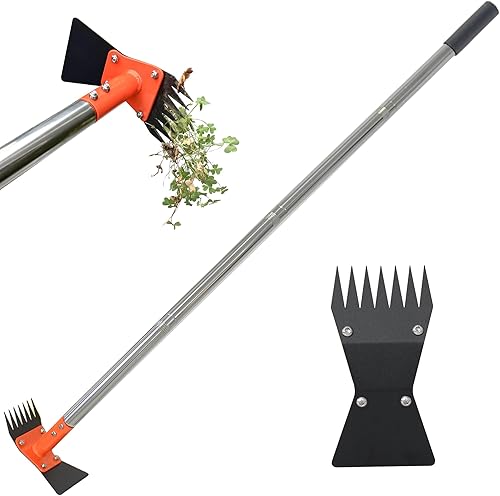
Best for: Dual-purpose cultivation tasks
This 2-in-1 design combines a 3.75″ rake with trapezoid hoe blade, enabling both weed extraction and soil loosening without tool changes. Tempered spring steel construction resists bending under levering forces that might deform standard carbon steel heads. The adjustable 61″ handle accommodates various heights and tight spaces by shortening for raised beds or extending for open ground. Sand texture finish improves grip in wet conditions while resisting corrosion. Versatility makes it suitable for gardeners managing diverse zones from flower beds to gravel driveways.
The dual-function head adds weight compared to dedicated pullers, potentially increasing arm fatigue during pure weeding sessions. Assembly requires locking every handle section securely; improper tightening could cause wobble during use. Buyers seeking primary weed removal should weigh whether occasional soil prep justifies the trade-off in extraction precision.
Pros
- Dual hoe and rake functions
- Adjustable 61″ handle length
- Spring steel resists bending
- Corrosion-resistant sand finish
- Works across varied garden zones
Cons
- Heavier than dedicated pullers
- Four-section assembly required
- Less precise on deep taproots
5. DonSail Hoe Garden Tool -Scuffle Garden Hoes

Best for: Push-pull surface weeding
The stirrup hoe design uses push-pull motion to slice weed roots just below soil surface without disturbing nearby plants, making it ideal for maintaining established beds. Commercial-grade 1.3″ diameter steel tubing provides rigidity during lateral cutting forces that would flex thinner handles. Adjustable length from 30″ to 60″ serves both detailed close work and standing operation. Hollow steel construction keeps weight manageable despite sturdy build, allowing comfortable use by different family members. This approach prevents regrowth by severing roots rather than extracting them.
However, scuffle hoes don’t remove entire root systems like claw pullers, meaning perennial weeds may resprout requiring repeat passes. The technique differs significantly from stabbing motions, demanding adjustment period for users accustomed to traditional methods. Best results come from regular maintenance rather than reclaiming overgrown areas. Those dealing with established infestations or wanting permanent removal should understand this tool maintains rather than eradicates. It complements but doesn’t replace extraction tools for initial clearance.
Pros
- Safe around established plants
- Sturdy 1.3″ steel tubing
- Three adjustable length options
- Lightweight hollow construction
- Prevents soil disturbance
Cons
- Doesn’t extract full root systems
- Requires technique adjustment
- Better for maintenance than clearance
6. Garvee 40″ Long Handle Stand Up Weed Puller
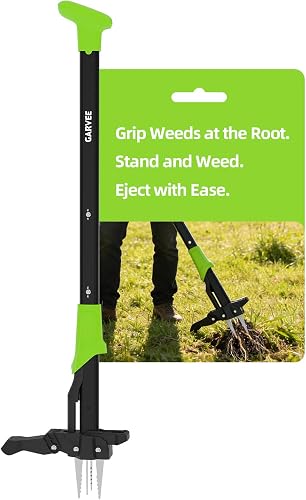
Best for: Compact storage and ambidextrous use
At 40″ with easy-eject mechanism, this model balances portability with functional reach for smaller gardens or shed storage constraints. The offset handle and viewing window mirror premium ergonomic features while accommodating both left and right-handed users equally. Weight-tested multi-claw design claims greater strength than competitors, backed by lifetime warranty for long-term assurance. Easy-eject system speeds disposal during high-volume sessions without bending to clear claws manually. Chemical-free operation ensures safety around children and pets playing in treated areas.
The shorter 40″ length may still require slight bending for taller individuals, partially compromising the stand-up benefit. While effective in soft ground after rain, performance drops noticeably on hard clay or rocky surfaces as noted. Users prioritizing maximum reach or working predominantly in difficult soil should evaluate whether compact convenience outweighs these operational limits. Ambidextrous design helps households with multiple gardeners sharing equipment.
Pros
- Compact 40″ for easy storage
- Ambidextrous offset handle design
- Easy-eject speeds disposal
- Lifetime warranty included
- Controls weeds without harmful chemicals, safe for children, pets, and Mother Nature
Cons
- Shorter reach for tall users
- Reduced effectiveness on hard soil
7. GOXAWEE Stand Up Weed Puller Tool with 45″ Long Handle

Best for: Maximum reach and adjustability
Two-level adjustable handle extends from 33″ to 45″, accommodating children learning garden care alongside adults without separate tools. Solid steel construction from handle to head contains no plastic parts. Precision gripping head locks onto taproots for complete extraction, preventing regrowth from leftover fragments. Balanced design lets gravity assist penetration, reducing physical effort during large-area maintenance. Breakdown into three rods enables compact seasonal storage or transport between properties.
The 45″ maximum length, while generous, still falls short of true tall-user solutions exceeding 60″. Steel-only build increases overall weight versus bamboo or hybrid alternatives, potentially tiring arms during extended use. Assembly requires securing three rod sections properly; loose connections compromise leverage safety. Ideal for vegetable plots and slopes where adaptability matters, but less specialized for pure lawn dandelion removal than dedicated pullers. Versatility comes with trade-offs in optimized single-task performance.
Pros
- Adjustable 33″ to 45″ length
- All-steel durable construction
- Complete root extraction design
- Balanced leverage reduces effort
- Compact three-rod breakdown
Cons
- Heavier than bamboo alternatives
- Three-section assembly needed
- Not specialized for lawns
8. Backyard Expressions Stand Up Weed

Best for: Bamboo handle enthusiasts
The 46″ bamboo handle offers extended reach beyond standard 45″ models while retaining natural warmth and vibration damping properties. Heavy-duty stainless steel extraction head resists rust across seasons without protective coatings that wear off. Full disassembly facilitates apartment balcony storage or garage organization where space is limited. Built-in hanging holes enable pegboard mounting for quick access. Chemical-free extraction aligns with organic gardening principles while protecting household members and wildlife from herbicide exposure.
Bamboo requires occasional oiling to prevent drying cracks, adding maintenance steps steel handles avoid. Despite “tackle any soil type” claims, stainless steel claws typically perform best in moist conditions like other multi-pronged designs. The 46″ length benefits average-to-tall users but may still be insufficient for very tall individuals. Lifetime warranty provides reassurance, though bamboo longevity depends heavily on storage conditions. Best for those valuing natural materials and willing to maintain them properly.
Pros
- Extended 46″ bamboo reach
- Rust-resistant stainless claws
- Three-part compact disassembly
- Built-in hanging storage holes
- Organic gardening compatible
Cons
- Bamboo needs periodic oiling
- Best performance in moist soil
- May be short for very tall users
9. Stainless Steel Stand Up Weeder
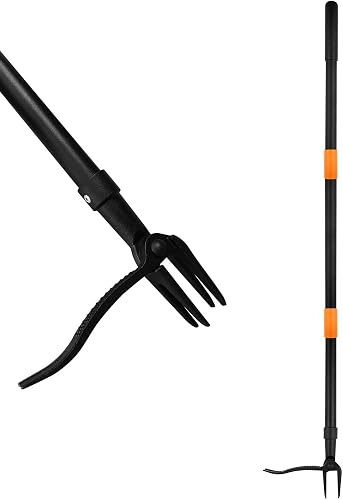
Best for: Precise height customization
Adjustable 47.8″ total length via three sections allows fine-tuning beyond fixed-size options, optimizing posture for individual biomechanics. 0.04-inch thick stainless steel handle balances bend resistance with maneuverability, avoiding bulkier tubes that tire wrists. 1035 steel claws offer higher carbon content than standard stainless, improving edge retention and penetration in moderate soils. Tool-free assembly enables quick adjustments between users or tasks without carrying wrenches. Extended length serves taller gardeners better than 45″ models while remaining manageable for storage.
Multiple connection points introduce potential looseness over years of adjustment cycles. The 47.8″ length, while generous, still trails 60″+ options for maximum standing comfort. After-sales support promises exist but lack specificity on response times or replacement policies. Best for households with multiple height ranges needing one adaptable tool rather than several fixed ones.
Pros
- Precise 47.8″ adjustable length
- Tool-free section assembly
- High-carbon 1035 steel claws
- Balanced handle thickness
- Multi-user height adaptation
Cons
- Carbon steel may surface rust
- Support policy unspecified
10. Garvee 40″ Long Handle Stand Up Weed Puller
Best for: Quick-release efficiency
Easy-eject mechanism clears extracted weeds instantly without manual picking, maintaining workflow rhythm during large jobs. Integrated viewing window confirms claw engagement before lifting, reducing false pulls that disturb soil unnecessarily. Offset handle geometry minimizes repetitive strain injuries for frequent gardeners. Weight-tested multi-pronged construction withstands levering forces that deform lighter designs. Lifetime warranty and ambidextrous usability make it practical shared equipment for couples or community gardens.
The 40″ length prioritizes compactness over maximum ergonomics, potentially limiting standing comfort for very tall users. Performance degrades on hard clay or rocky surfaces as explicitly stated, restricting optimal use to prepared beds or post-rain timing. Best for maintained landscapes with accessible soil rather than reclamation projects. Efficiency gains matter most when volume justifies mechanical complexity.
Pros
- Instant easy-eject clearing
- Viewing window prevents misses
- Repetitive strain reduction
- Ambidextrous lifetime warranty
- Shared-use practicality
Cons
- Compact 40″ limits tall users
- Poor hard clay performance
- Ejector springs may fatigue
Who Should Buy Which
Grampa’s Weeder Original suits traditionalists wanting proven simplicity in regularly watered gardens. Fiskars Deluxe Stand-Up serves detail-oriented gardeners tackling fibrous weeds in amended beds who value visual confirmation. WilFiks Weed Puller fits seniors or newcomers prioritizing gentle introduction over aggressive capability. Garvee Hoe and Rake benefits multi-taskers maintaining diverse zones who accept trade-offs in extraction depth. DonSail Scuffle Hoe works for established bed maintenance where root slicing suffices. GOXAWEE Stand Up accommodates families needing child-to-adult adjustability without plastic components. Backyard Expressions appeals to natural material purists willing to maintain bamboo. WICING Stainless Steel serves multi-height households requiring precise customization. Both Garvee 40″ models target space-constrained users accepting shorter reach for ejector convenience and storage ease.
Mistakes That Catch Buyers Out
Assuming all multi-pronged designs perform identically in dry clay leads to frustration when tools deflect instead of penetrating. Choosing ejector mechanisms for sticky soil creates constant cleaning interruptions that negate time savings. Ignoring handle length specifications relative to personal height results in continued bending despite stand-up claims. Trusting “works on all soil types” marketing without checking moisture prerequisites sets unrealistic expectations for immediate results in unprepared ground.
To weed a garden without kneeling, measure your hip-to-floor distance before ordering to ensure the selected handle length truly enables upright posture. The Grampa’s Weeder Original remains the safest starting point for mixed conditions due to its documented century-long track record in moist soil, but success depends entirely on matching tool mechanics to your actual ground state rather than aspirational garden visions.
Frequently Asked Questions
Can stand-up weeders remove deep taproots completely?
Yes, when used correctly in appropriate soil moisture. Tools with multi-pronged designs like Grampa’s Weeder Original penetrate deeply enough to extract dandelion taproots intact, but only after rainfall or watering softens resistance. Dry clay prevents full penetration regardless of claw sharpness. Success depends on timing usage to soil conditions rather than forcing extraction in hardened ground. Always water thoroughly 30-60 minutes before attempting deep root removal for complete extraction.
Are adjustable handles as sturdy as fixed-length models?
Adjustable handles using locking mechanisms are generally secure when properly tightened before each use, though connection points represent potential wear areas over years. Fixed-length bamboo or steel handles eliminate joint failure possibilities entirely. For heavy daily use in challenging soil, fixed designs offer marginally greater long-term reliability. Occasional gardeners benefit more from adjustability’s versatility than they lose in theoretical durability. Check locking engagement before applying leverage.
Do serrated claws stay sharp indefinitely?
Stainless steel serrations resist dulling better than carbon steel but gradually lose bite after years of abrasive soil contact. They don’t require sharpening like knives but may eventually slide off tough roots rather than gripping. Most listings don’t specify edge lifespan because degradation depends on soil mineral content and usage frequency. Replacement heads restore original performance if available. Monitor extraction effectiveness annually; declining grip indicates wear rather than user error.
Can children safely use adult stand-up weeders?
Adjustable models like GOXAWEE Stand Up accommodate smaller statures by shortening to 33″, enabling supervised participation without oversized tools. Fixed-length options over 40″ typically exceed safe control ranges for young users. Weight matters as much as length; steel-only constructions tire small arms quickly. Supervision remains essential regardless of sizing. Teach proper technique emphasizing controlled motions rather than forceful stabbing. Start with soft-soil practice areas before progressing to tougher weeds.
How do I maintain bamboo handles seasonally?
Bamboo requires annual application of linseed or tung oil to prevent drying cracks and moisture damage. Store indoors or covered during winter to avoid freeze-thaw cycling that splits fibers. Unlike steel, bamboo deteriorates visibly when neglected but responds well to preventive care. Properly maintained bamboo lasts decades; ignored handles fail within seasons.
Conclusion
You’ll save your back and get better results when you match the tool to your actual soil. Grab a stand-up weeder that fits your garden’s texture, then spend ten minutes testing it on a few stubborn weeds before committing to a full afternoon of work.
{“@context”:”https://schema.org”,”@type”:”FAQPage”,”mainEntity”:[{“@type”:”Question”,”name”:”Can stand-up weeders remove deep taproots completely?”,”acceptedAnswer”:{“@type”:”Answer”,”text”:”Yes, when used correctly in appropriate soil moisture. Tools with multi-pronged designs like Grampa’s Weeder Original penetrate deeply enough to extract dandelion taproots intact, but only after rainfall or watering softens resistance. Dry clay prevents full penetration regardless of claw sharpness. Success depends on timing usage to soil conditions rather than forcing extraction in hardened ground. Always water thoroughly 30-60 minutes before attempting deep root removal for complete extraction.”}},{“@type”:”Question”,”name”:”Are adjustable handles as sturdy as fixed-length models?”,”acceptedAnswer”:{“@type”:”Answer”,”text”:”Adjustable handles using locking mechanisms are generally secure when properly tightened before each use, though connection points represent potential wear areas over years. Fixed-length bamboo or steel handles eliminate joint failure possibilities entirely. For heavy daily use in challenging soil, fixed designs offer marginally greater long-term reliability. Occasional gardeners benefit more from adjustability’s versatility than they lose in theoretical durability. Check locking engagement before applying leverage.”}},{“@type”:”Question”,”name”:”Do serrated claws stay sharp indefinitely?”,”acceptedAnswer”:{“@type”:”Answer”,”text”:”Stainless steel serrations resist dulling better than carbon steel but gradually lose bite after years of abrasive soil contact. They don’t require sharpening like knives but may eventually slide off tough roots rather than gripping. Most listings don’t specify edge lifespan because degradation depends on soil mineral content and usage frequency. Replacement heads restore original performance if available. Monitor extraction effectiveness annually; declining grip indicates wear rather than user error.”}},{“@type”:”Question”,”name”:”Can children safely use adult stand-up weeders?”,”acceptedAnswer”:{“@type”:”Answer”,”text”:”Adjustable models like GOXAWEE Stand Up accommodate smaller statures by shortening to 33\”, enabling supervised participation without oversized tools. Fixed-length options over 40\” typically exceed safe control ranges for young users. Weight matters as much as length; steel-only constructions tire small arms quickly. Supervision remains essential regardless of sizing. Teach proper technique emphasizing controlled motions rather than forceful stabbing. Start with soft-soil practice areas before progressing to tougher weeds.”}},{“@type”:”Question”,”name”:”How do I maintain bamboo handles seasonally?”,”acceptedAnswer”:{“@type”:”Answer”,”text”:”Bamboo requires annual application of linseed or tung oil to prevent drying cracks and moisture damage. Store indoors or covered during winter to avoid freeze-thaw cycling that splits fibers. Unlike steel, bamboo deteriorates visibly when neglected but responds well to preventive care. Properly maintained bamboo lasts decades; ignored handles fail within seasons.”}}]}


2 Comments
Does Weeding Count as Exercise? Calories and CDC Verdict
October 02, 2026, at 4:43 pm[…] choice creates a trade-off. A long-handled hoe saves your knees and back but reduces the total calorie burn because your legs stay still. Hand-pulling builds grip strength […]
VEVOR Garden Kneeler and Seat Heavy Review
October 02, 2026, at 11:09 pm[…] and the ground, and its role is specifically tied to fatigue reduction during repetitive tasks. The listing states it helps minimize discomfort during weeding, planting, and pruning, which are activities that typically involve sustained pressure on […]