



As an Amazon Associate, we earn from qualifying purchases. This post contains affiliate links – if you buy through them, we may earn a commission at no extra cost to you.
You’re choosing between ten best grow lights that cover everything from single pots to full tents. What separates them isn’t just power. It’s how they mount, what spectrum they give, and whether they need a fan. A shelf light won’t run a tent, and a floor lamp can’t clip to a desk.
Best overall: MARS HYDRO TS1000 — its 150W output and patented reflector hood deliver even coverage across a 3x3ft space without any fan noise. Best for dedicated grow tents: Spider Farmer SF1000 — it pairs a 2.5 µmol/J efficiency rating with a five-year warranty backed by local maintenance centers. Best for living spaces: FECiDA 76in — the stable base and height-adjustable rods let it stand like regular furniture while covering tall indoor plants.
The rest of this guide is for anyone trying to match a specific setup—like a wire shelf, a windowsill, or a single potted monstera—to the right fixture.
How We Picked
To earn a spot, a listing had to state exact figures: LED count, wattage, coverage area, or spectrum wavelengths. We looked at what came in the box, how the light mounts, and what warranty the seller actually covers.
1. MARS HYDRO 150W TS1000 LED Grow Light

Best for: Growers needing quiet, even canopy coverage indoors.
The MARS HYDRO TS1000 uses a patented white reflector hood with a 120° refraction angle. This design increases light utilization by 25%, meaning less energy bounces off your walls and more hits the leaves. In daily use, that translates to stronger growth without moving the fixture closer and risking heat damage.
It draws only 150W using 354 SMD LEDs, replacing a traditional 250-watt HPS bulb. The diodes are packed densely in the middle and spaced out on the edges. That layout keeps the light uniform across a 2.5×2.5ft core area, reaching a maximum of 3x3ft. Because it’s completely fanless, you’ll never hear a motor humming over your ventilation system.
This fixture isn’t for someone growing a single houseplant on a bookshelf. Its 120VAC/240VAC/277VAC driver and daisy-chain capability (up to 50 units) are built for dedicated grow spaces where you control the environment.
Pros
- Patented reflective hood boosts light utilization significantly
- Fanless aluminum build runs completely silent
- Dimmable from zero to one hundred percent
Cons
- RJ12 daisy chain connector sold separately
- Too powerful for casual single-plant use
2. Spider Farmer SF1000 LED Grow Lights

Best for: Tent growers wanting long-term warranty protection.
The Spider Farmer SF1000 delivers a system PPE of 2.5 µmol/J. That high efficiency means it converts electricity into usable plant light better than older diode styles. For a grower running lights eighteen hours a day during flowering, that efficiency keeps the electrical draw down while maintaining strong yields.
Its 2026 version uses 100W and arranges diodes gathered at the edge. This makes the PPFD map much more uniform across a 2x2ft or 3x3ft tent footprint. The spectrum includes 3000K, 5000K, 660nm red, and 760nm IR. The infrared diodes are intentionally dimmer to the human eye, but they speed up flowering time when plants absorb them.
It comes with a 5-year warranty serviced at local maintenance centers in the US, CA, UK, EU, and AU. However, this light isn’t for someone who wants a simple plug-and-play lamp for a living room corner.
Pros
- High 2.5 µmol/J efficiency rating
- Five-year warranty with local service centers
- Compatible with GGS controllers for scheduling
Cons
- IR diodes appear very dim to eyes
- Requires proper tent hanging setup
3. Barrina LED Grow Light

Best for: Large canopies needing maximum LED density.
The Barrina 4×4 Panel packs 720 LEDs into a single fixture drawing 200W. That massive diode count spreads light evenly over a 4x4ft area during the vegetative stage, or a 3x3ft space when plants are flowering. If you’re filling a large tray with seedlings, this wide footprint prevents dark spots at the edges.
It blends 5000K blue, 3000K warm white, 660nm red, and 730nm IR. The listing states this combination saves up to 50% energy compared to HPS or blurple lamps. In practice, the 660nm red and IR specifically target the bloom phase, pushing flowers to grow larger and faster than a basic white-light panel would.
This isn’t the right pick for a small desktop herb garden. The 200W draw and 4x4ft coverage are meant for serious indoor gardening setups where maximizing canopy space matters more than keeping the fixture tiny.
Pros
- Massive 720 LED count ensures uniformity
- Covers up to 4x4ft for veg stage
- Includes targeted 660nm red and IR
Cons
- 200W draw too high for small spaces
- Coverage shrinks to 3x3ft when flowering
4. Barrina T5 Grow Lights
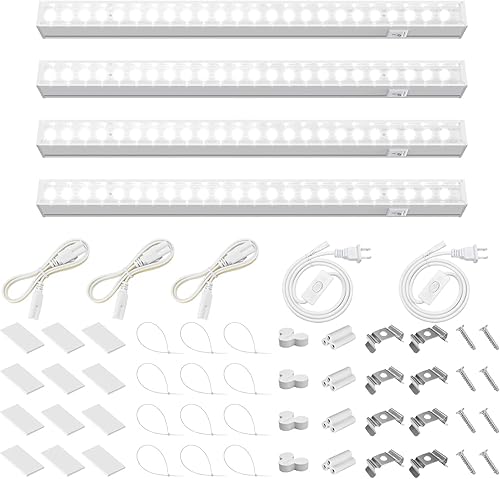
Best for: Shelving setups needing modular strip lighting.
The Barrina T5 comes as a four-pack of 1-foot strips, each consuming 20W with 96 LEDs. You get separate on/off switches on each housing, so you can run two strips for seedlings and all four for heavy feeders. This modularity means you only use the power your current growth stage demands.
They emit a 5000K white full spectrum that replaces 120W general plant lights per strip. Installation takes minutes using the included double-sided tapes, clips, and cable ties. You can link up to 16 lights in a series, which lets you wire an entire multi-tier shelf rack to a single power source without a mess of cords.
Don’t buy these for deep-canopy plants like tomatoes. The listing notes this T5 plant light is non-magnetic. They excel at close-range lighting for leafy greens, succulents, or starting seeds where the light sits just inches above the soil.
Pros
- Individual switches allow precise power control
- Links up to sixteen units in series
- Includes all mounting hardware in box
Cons
- Non-magnetic design limits metal mounting
- Only suited for low-canopy close-range plants
5. LEOTER 80 LED

Best for: Desk growers needing flexible directional lighting.
The LEOTER 80 LED uses four adjustable goosenecks holding 80 total diodes. You can point one neck at a tall plant and another at a trailing pothos. It offers three spectral modes: full spectrum (380nm-800nm), red/blue mix, or a combined mode. Switching between them lets you favor root growth or blooming depending on the season.
A circular memory timer sets the light to run for 3, 9, or 12 hours automatically. Once set, it turns itself on and off daily without manual plugging. The aviation-grade heat sink keeps the unit cool enough to touch, which matters when it’s clamped directly to a wooden desk or thin shelf edge.
The USB-powered design and clamp mount are strictly for houseplants and office greenery. Also, remember that the timer resets entirely if the light loses power from the outlet.
Pros
- Four flexible necks aim light precisely
- Three distinct spectral modes for different stages
- Built-in memory timer automates daily schedules
Cons
- Timer resets completely if power drops
6. FECiDA 76″ Floor Lamp Grow Light with Stable Base

Best for: Tall houseplants needing freestanding living room light.
The FECiDA 76in stands on a stable base designed to look like regular furniture. It adjusts from 40 to 76 inches tall using one, two, or three link rods. You can raise the head as your monstera or indoor tree grows, keeping the 208 LEDs at the perfect distance without buying a new fixture.
It outputs 2000 Lumens, equivalent to a 200W incandescent bulb. The spectrum mixes 3000K, 5000K, 660nm, and UV-IR LEDs in a professional ratio. A 5-mode timer allows 4, 8, 12, 16, or 20-hour cycles by pressing buttons together. Since it plugs directly into a home socket without an adapter block, there’s one less part to fail over years of use.
This light isn’t meant for enclosed grow tents. It’s a living-room piece. While it supports daisy-chaining up to three units via input/output sockets, the decorative design prioritizes aesthetics over raw agricultural yield.
Pros
- Stable base prevents tipping near pets
- Height adjusts up to seventy-six inches easily
- Plugs directly in without external adapter
Cons
- Decorative focus over raw agricultural power
7. LBW 642 LED

Best for: Multi-plant setups needing a height-adjustable tripod.
The LBW 642 LED features three panels totaling 642 chips. Each panel holds 214 diodes mixing cold white, warm white, red, and natural light. The back plate uses a unique patterned mold with reserved holes for heat dissipation. This keeps the plastic outer shell and aluminum panel cool during long 12-hour photoperiods.
It includes a 1.5m tripod that adjusts from 27.8 to 63 inches. You can switch off individual panels when not needed, saving power while still covering a wide floor area. The 3/6/12H timer operates on a 24-hour cycle, and six brightness levels let you dial down intensity for delicate ferns.
This isn’t for growers who want a permanent ceiling-hung system. The tripod takes up floor space and can be bumped in busy hallways. The 12-month warranty plus 30-day return guarantee is standard, but shorter than the longest coverage periods offered by competing brands.
Pros
- A multi-panel layout offers wide coverage
- Individual panels switch off to save power
- Tripod adjusts height from 27.8 to 63 inches
Cons
- Tripod footprint takes up floor space
- Warranty shorter than premium tent fixtures
8. Briignite Grow Light Bulbs

Best for: Standard lamp users wanting invisible grow lighting.
The Briignite A19 fits any standard E26 socket. It looks like a normal 4000K white bulb to your eyes, but it emits the red and blue wavelengths plants need. You can screw it into a living room floor lamp and grow herbs without turning your space purple. It delivers 1000 Lumens across a 180-degree beam angle.
It draws only 11 watts while matching a 100W traditional bulb’s output. The PPF hits 25 micromoles per second, which is plenty for leafy greens and tomatoes in standard home fixtures. A plastic and aluminum cooling system keeps heat low, supporting a rated lifespan of up to 25,000 hours.
Don’t use this as your only light for a flowering cannabis crop in a tent. It’s a supplemental or single-houseplant bulb. The 180-degree spread means light goes everywhere, unlike focused panel lenses that push photons straight down into a canopy.
Pros
- Fits standard E26 home lamp sockets
- Appears as natural 4000K white light
- Draws only eleven watts of actual power
Cons
- Wide spread wastes light outside canopy
- Not powerful enough for dense flowering crops
9. FECiDA High Output Flat Panel Grow Lights
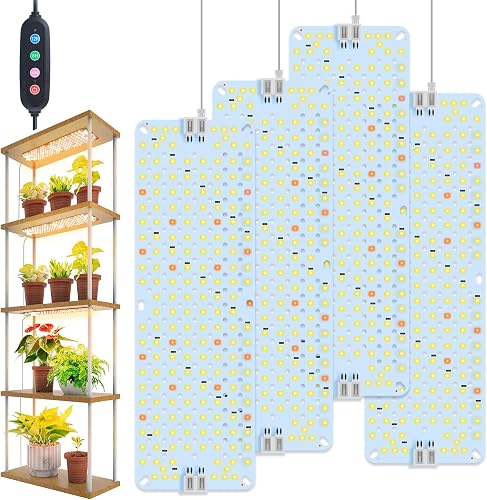
Best for: Wire shelving units needing clean hidden wiring.
The FECiDA Flat Panel comes in a 4-pack designed specifically for common plant shelves. Each panel uses 192 LEDs drawing 12W of actual power. They connect via both series and parallel options, letting you route wires cleanly along shelf poles without dangling cords. This modular approach keeps a multi-tier rack looking organized.
The spectrum blends 3000K, 5000K, and 660nm red. Like the brand’s floor lamp, it includes a 5-mode timer for 4, 8, 12, 16, or 20 hours. You press two buttons together to reach the longer durations. The flat shape slides right under a cabinet or seed tray, putting light inches away from sprouting leaves where it’s most effective.
These aren’t for open-floor growing. Their low profile and 12W draw mean they rely on proximity to work. If you place them too high above mature plants, the light scatters before reaching the lower leaves. They’re purpose-built for tight vertical spaces.
Pros
- Series and parallel connections hide messy cables
- Four panels perfectly fit standard wire shelves
- Low profile installs flush under cabinets
Cons
- Must sit very close to plant canopy
- Long timer modes require pressing two buttons
10. Yadoker Halo
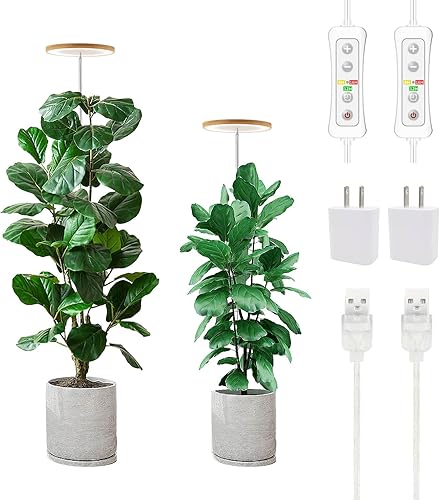
Best for: Potted plants needing direct soil-stake lighting.
The Yadoker Halo features a 6.3-inch disc with 72 LEDs covering 380nm to 800nm. It mixes 5000K white, 3000K warm white, red, and blue diodes. The pointed stake pushes directly into your planter’s soil. No tools, no wall mounts—just stick it in the dirt next to your favorite houseplant and plug it in.
The telescopic pole extends from 13.7 to 61.1 inches. As your plant stretches upward, you pull the pole higher to maintain the right gap. Ten dimming levels run from a soft 10% glow to full 100% power. It runs on 5V low voltage via USB, staying cool enough to safely leave on for 16 hours using the auto timer.
This isn’t for outdoor gardens or heavy fruiting crops. It’s a plug-in device, not battery-powered, so your pot must stay near an outlet. The UL-listed and CE-compliant build ensures safety for continuous indoor use around dry soil and water spills.
Pros
- Stake pushes directly into potting soil
- Extends up to 61.1 inches as plants grow
- Runs safely on 5V low USB voltage
Cons
- Must remain plugged into USB power source
- Single halo ring covers limited horizontal area
Also Worth Considering
The KingLED KING1000 Grow Light targets 2×2, 2×3, and 2×4 ft tents, making it a flexible option if your tent size changes often. The VIVOSUN LumaLight LED Grow Light offers a 100W full-spectrum output, fitting neatly into smaller enclosed spaces where high wattage isn’t required. The SANSI Grow Lights provide 36W of power, which suits single-plant setups or supplemental lighting where a massive panel would overwhelm the foliage.
How to Choose in Sixty Seconds
Which spectrum do my plants actually need?
Full spectrum is the safest choice for mixed collections. A light combining 3000K warm white and 5000K cool white mimics natural sunlight well enough for most houseplants. If you’re growing leafy greens or starting seeds, prioritize fixtures heavy in blue wavelengths like 5000K. For flowering plants or fruiting vegetables, you need 660nm red and 730nm infrared diodes. These specific wavelengths trigger blooming hormones that plain white light can’t fully activate. Check the listing’s nanometer breakdown before ordering. A fixture advertising “full spectrum” without listing actual nm numbers might just be a standard white bulb hiding behind marketing terms.
Does wattage equal growing power?
No, wattage only tells you how much electricity the fixture pulls from your wall. Actual growing power depends on PPF (Photosynthetic Photon Flux) and how efficiently the diodes convert that electricity into usable light. A 100W fixture with modern SMD LEDs will often outgrow a 200W older blurple panel. Look for metrics like µmol/J to judge efficiency. Higher numbers mean more light reaches the leaves per watt spent. Don’t buy based solely on the highest wattage number printed on the box. Instead, match the manufacturer’s stated coverage area to your actual growing space dimensions.
Do I really need a built-in timer?
A built-in timer removes the daily chore of plugging and unplugging your lights. Plants thrive on consistent photoperiods, usually 12 to 16 hours of light followed by total darkness. If your schedule is unpredictable, a timer protects your plants from accidental 24-hour exposure that causes stress. However, timers add electronic complexity. If the unit loses power, many built-in timers reset entirely, forcing you to reprogram them. If you already own a reliable smart plug or mechanical outlet timer, you don’t strictly need one built into the fixture. Buy the light for its diodes first, and treat the timer as a helpful bonus.
If you want to understand exactly how plants process these artificial wavelengths, reading about photosynthetically active radiation from the U.S. Department of Energy explains why specific nanometers matter more than raw brightness.
The MARS HYDRO TS1000 remains the strongest overall pick because its reflector hood and fanless build handle real growing environments quietly. If your plants live in your living room rather than a tent, the FECiDA 76in gives you the height and stability tall houseplants demand without looking like industrial equipment. Your next step is measuring your actual growing space—whether it’s a shelf width, a tent footprint, or a pot diameter—and matching those inches to the coverage specs listed above before clicking through to check today’s availability.
Frequently Asked Questions
What kind of power setup do these lights require?
Most panel lights like the MARS HYDRO TS1000 and Spider Farmer SF1000 plug directly into standard 120VAC home outlets, though the Mars Hydro also supports 240VAC and 277VAC for commercial rooms. Smaller units differ greatly; the LEOTER 80 LED and Yadoker Halo run on 5V USB power. Always confirm your outlet type before ordering.
What maintenance do grow lights need after installation?
LED grow lights require very little physical maintenance, but dust buildup is the silent killer of output. Wipe the surface gently with a dry microfiber cloth every few weeks, avoiding liquid cleaners that can damage internal drivers. For fanless models like the Barrina 4×4 Panel, ensure the aluminum heat sinks have breathing room.
Which part of a grow light fails first?
The internal driver or power supply typically fails before the LED diodes themselves. Diodes are solid-state components rated for tens of thousands of hours, but the capacitors inside the driver degrade faster, especially in hot environments. This is why fanless designs with thick aluminum heat sinks, like those on the Spider Farmer SF1000, matter.
Is a simple bulb enough instead of a panel?
Yes, if you’re only supplementing a sunny window or growing low-light houseplants like pothos or snake plants. The Briignite A19 screws into any standard lamp and provides 25 micromoles per second of PPF, which keeps foliage alive and slowly growing. However, a single bulb can’t replace the sun for heavy-feeding crops.
Conclusion
Pick the one that fits your space, hang it up, and watch how your plants respond over the next few weeks. You’ll see new growth or yellowing leaves pretty quickly. Don’t be afraid to raise or lower the fixture—small adjustments make all the difference.
{“@context”:”https://schema.org”,”@type”:”FAQPage”,”mainEntity”:[{“@type”:”Question”,”name”:”What kind of power setup do these lights require?”,”acceptedAnswer”:{“@type”:”Answer”,”text”:”Most panel lights like the MARS HYDRO TS1000 and Spider Farmer SF1000 plug directly into standard 120VAC home outlets, though the Mars Hydro also supports 240VAC and 277VAC for commercial rooms. Smaller units differ greatly; the LEOTER 80 LED and Yadoker Halo run on 5V USB power. Always confirm your outlet type before ordering.”}},{“@type”:”Question”,”name”:”What maintenance do grow lights need after installation?”,”acceptedAnswer”:{“@type”:”Answer”,”text”:”LED grow lights require very little physical maintenance, but dust buildup is the silent killer of output. Wipe the surface gently with a dry microfiber cloth every few weeks, avoiding liquid cleaners that can damage internal drivers. For fanless models like the Barrina 4×4 Panel, ensure the aluminum heat sinks have breathing room.”}},{“@type”:”Question”,”name”:”Which part of a grow light fails first?”,”acceptedAnswer”:{“@type”:”Answer”,”text”:”The internal driver or power supply typically fails before the LED diodes themselves. Diodes are solid-state components rated for tens of thousands of hours, but the capacitors inside the driver degrade faster, especially in hot environments. This is why fanless designs with thick aluminum heat sinks, like those on the Spider Farmer SF1000, matter.”}},{“@type”:”Question”,”name”:”Is a simple bulb enough instead of a panel?”,”acceptedAnswer”:{“@type”:”Answer”,”text”:”Yes, if you’re only supplementing a sunny window or growing low-light houseplants like pothos or snake plants. The Briignite A19 screws into any standard lamp and provides 25 micromoles per second of PPF, which keeps foliage alive and slowly growing. However, a single bulb can’t replace the sun for heavy-feeding crops.”}}]}


